


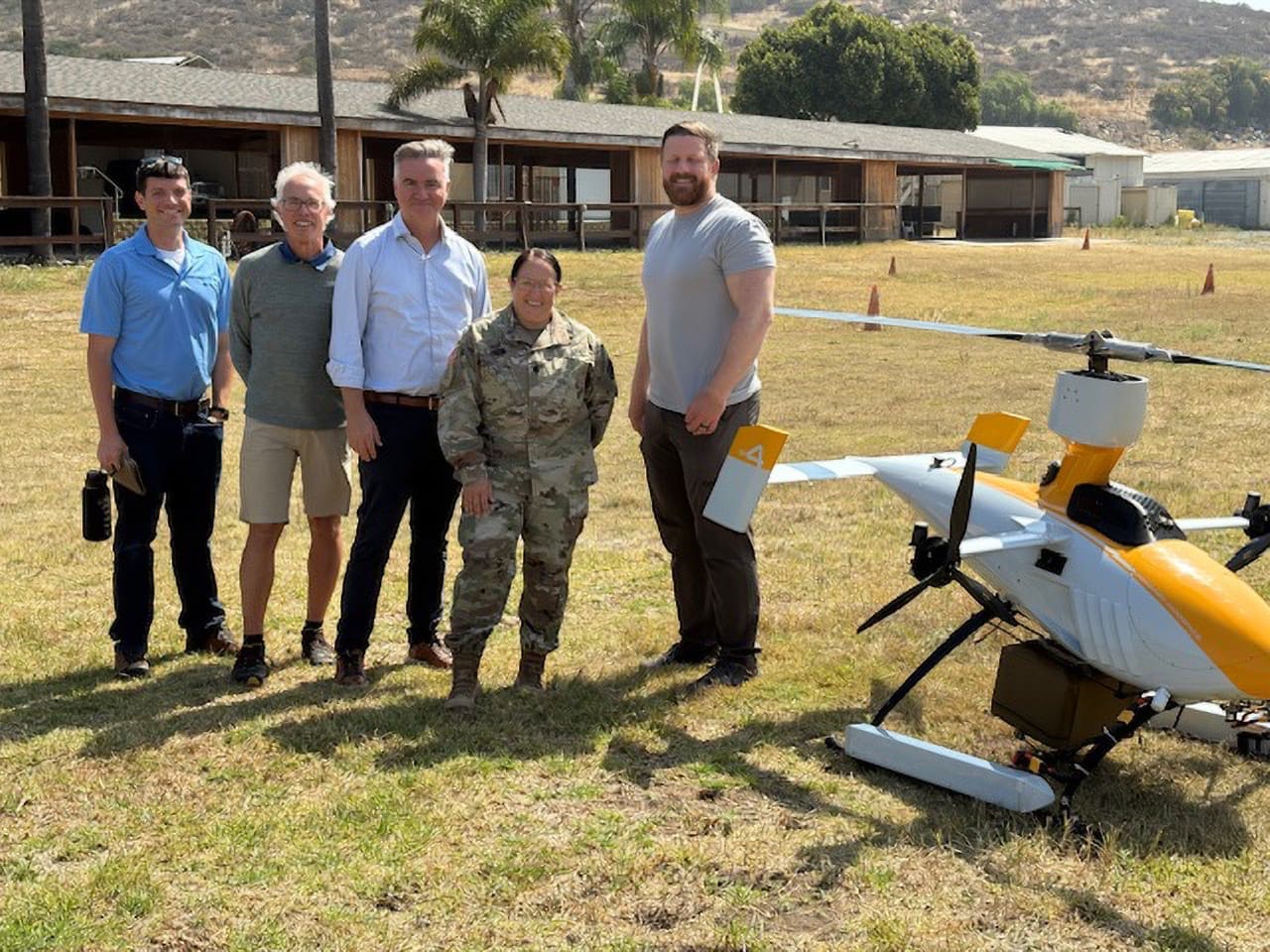
SAN DIEGO, CA — Unmanned Aerospace welcomed representatives from the U.S. Navy to its San Diego flight operations for an in-person program review and a series of live GH-4 flight exercises, giving the Navy team a firsthand look at the next-generation VTOL rotorcraft now maturing under the two organizations’ ongoing partnership.
Navy program representatives met with Unmanned Aerospace leadership and flight crew on the airfield, where the GH-4 was staged, briefed and flown. Convening on site let both teams walk through program milestones, review progress against technical objectives, and watch the aircraft demonstrate the capabilities that make it distinct.
A Firsthand Look at the GH-4 in Flight
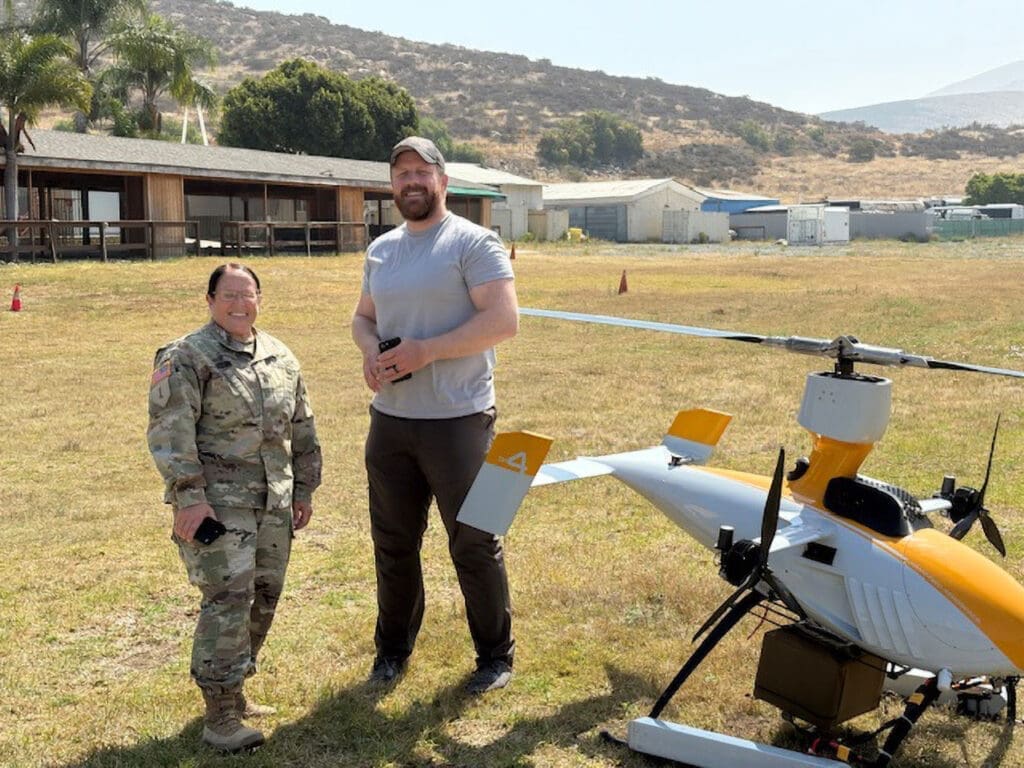
The GH-4 took center stage. Short for ”Gyrocopter-Helicopter, 4th generation,” the aircraft pairs the vertical take-off and landing capability of a helicopter with the long-range, forward-flight efficiency of an autogyro. Its patented Automatic Pitch System (APS) allows the overhead rotor to change blade pitch on demand: enabling the GH-4 to take off and hover like a helicopter, then transition to efficient wind-powered autorotation in cruise, where it consumes less energy in forward flight.
The flight exercises let the Navy team observe take-off, hover, and forward-flight transitions directly, confirming that the technology behind the GH-4 performs as designed.
U.S. Navy Support
Unmanned Aerospace’s work with the GH-4 is being advanced in partnership with the U.S. Navy and OECIF — a relationship that puts the aircraft in front of some of the most demanding evaluators in aviation. The Navy is under contract to test the hydrogen fuel cell-powered GH-4, alongside a jet-fuel variant, to determine the aircraft’s applicability across real-world mission profiles.
Working alongside the Navy brings a valued perspective to the program. On-site reviews like this one keep teams aligned — progress is assessed, insights are exchanged, and the next set of objectives is set together.
Built to Scale
Scalability sits at the core of Unmanned Aerospace’s approach. The GH-4 is designed to grow. Its architecture supports evolution into larger rotorcraft with greater range and payload, without the mechanical complexity and maintenance burden of a conventional helicopter. The same design principles the Navy reviewed on the flight line are meant to carry into future, larger platforms, giving the program a clear runway well beyond its current airframe.
For Unmanned Aerospace, the day was a chance to demonstrate the GH-4 in-flight capabilities. One more step in a steadily advancing program, with the next milestones already in view.
To follow Unmanned Aerospace and the GH-4 journey, visit www.Unmanned-Aerospace.com and connect with us on LinkedIn.

